
Executive presence is one of the most frequently requested – and least understood – areas of leadership development in coaching in Ireland.
Leaders are encouraged to show gravitas, be authentic and improve confidence to increase their chances of getting the top job. Yet little visibly changes. Feedback from others is indifferent; perceptions are mixed. The leader is stuck, frustrated that his results alone won’t get him to where he wants to go. What to do?
The problem is not that good executive presence itself is hard to obtain. The problem is how it is approached – it needs skilful interventions by a good manager, self-awareness on the part of the leader, time dedicated to put new behaviours into practice and regular, honest feedback.
Coaching helps but much executive presence coaching relies heavily on abstract frameworks and reflection, without translating insight into observable, measurable behavioural change. Leaders gain awareness, but not always impact. New practices don’t stick.
This is precisely the gap our Clarity-to-Confidence Framework™ has been designed to address.
From Insight to Impact: The Clarity-to-Confidence Framework™
The Clarity-to-Confidence Framework™ replaces guesswork with behavioural science.
Rather than focusing solely on who a leader is, it focuses on how a leader is experienced — and what specifically needs to change for that experience to shift. Its built using metrics from psychological assessment, grounded in coaching theory and delivered by skilled coaching from Natalie Bagnall.
It is a structured, time-bound approach that shifts a leader from insight to action to validated confidence, with coaching style metrics in typically 12–16 weeks.
Here is how it works:
The 3-Stage Clarity-to-Confidence Framework™
Stage 1: Diagnostic Phase (Weeks 1–2)
This phase establishes clarity — not only about what a leader does to come across as strong and confident, but also about how they are experienced. It identifies the base line of the leader’s executive presence, to understand the gap that needs to be narrowed between current and aspirational.
Psychometric profiling using for example EQ-i and The Leadership Circle creates a robust baseline. Alongside this, focused inquiry how the leader might be hindering their presence – perhaps where they lose confidence under pressure, or how their self-doubt might stand in their way of showing up authentically, and how their habitual responses weaken executive presence.
Insight from the field:
Peter was described by colleagues as highly competent, trusted by his clients, and dependable. However, feedback consistently suggested that he appeared too meek in meetings with seniors and lacked confidence when dealing with tricky stakeholders. He was being positioned for a more senior leadership role, yet perceptions of limited gravitas were beginning to hold him back.
In addition to psychometric data, Peter brought direct feedback from colleagues into the coaching session with Natalie Bagnall. And we experienced his communication style first-hand: cautious, contained, a bit wooden. When challenged or questioned, his voice softened, his posture tightened, and his impact diminished — despite the quality of his thinking.
Naming this observation in the room opened an important line of inquiry. Together, with Peter we explored what was happening internally at those moments and what his body and communication were signalling externally. This combination of data, feedback, and live relational insight allowed us to identify precisely what needed to change — and what did not.
The outcome of this phase was not a generic development plan but a clear understanding of the specific behaviours and communication patterns affecting Peter’s executive presence.
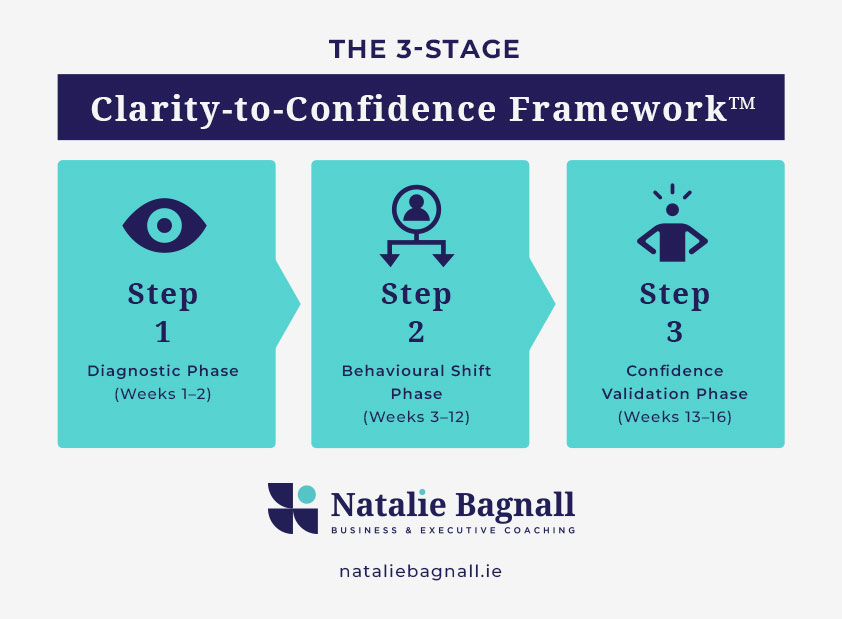
Stage 2: Behavioural Shift Phase (Weeks 3–12)
This is where insight becomes practice.
With the coach, leaders work to strengthen moment-to-moment awareness, stay present in challenging conversations, and communicate with greater clarity and authority. Through targeted coaching, complex issues are surfaced through frank, psychologically safe conversations and tested in real scenarios.
Insight from the field:
As the coaching progressed, Peter became increasingly aware of how he was coming across in senior forums and how his nervousness with larger groups and more senior stakeholders was undermining his impact. Video helped him hone into his facial expression and body language.
Through coaching, he identified the source of what we recognised as imposter syndrome. Unlike many of his peers, Peter had not followed a traditional academic route. He had worked his way up through the organisation from the bottom rung of the seniority ladder. In senior settings, this background quietly translated into a sense of being less worthy than colleagues who had progressed through more conventional, academic pathways.
Bringing this to his attention and making Peter comfortable discussing it were pivotal. Coaching helped Peter reframe his career path — not as a deficit, but as a significant strength. He recognised the depth of his organisational knowledge, his understanding of how teams truly operate, and his ability to connect authentically with people across all levels of the business.
Shining a light on the value of this less orthodox route allowed Peter to integrate it rather than compensate for it. As his internal stance shifted, so did his external presence. He began to speak with more ease, hold his ground more confidently in senior conversations, and communicate from a place of earned authority rather than self-doubt.
This internal shift created the foundation for sustainable behavioural change.
Stage 3: Confidence Validation Phase (Weeks 13–16)
Executive presence only exists if others experience the change.
In this final phase, structured stakeholder feedback loops assess whether behavioural and perceptual shifts have occurred. This includes repeat 360 data, qualitative interviews, and the leader’s own self-assessment.
Insight from the field:
In the final stages of the coaching, Peter repeated the 360 assessment and we conducted interviews with key stakeholders. He also completed a structured self-assessment.
In his own reflection, Peter noted a marked shift in how he felt with senior leaders and in larger group settings. He described feeling more grounded and less preoccupied with how he might be judged. Importantly, he could now identify which old patterns occasionally still appeared under pressure — and what he was increasingly able to choose differently in those moments.
Stakeholders described a noticeable change in Peter’s impact in the room. He was experienced as more confident, clearer in his messaging, and more at ease holding his position with senior colleagues. Feedback also highlighted areas for continued development, ensuring the process remained developmental rather than declarative.
Crucially, the coaching did not attempt to change what was authentic or effective about Peter’s leadership style. There was no effort to make him perform confidence or adopt a persona that felt unnatural. Instead, the focus was on strengthening the qualities he was already proud of, increasing his confidence in those areas, and reducing the influence of perceived gaps or deficits in his career narrative.
The result was an executive presence that felt credible, real, and sustainable — to Peter and to those around him.
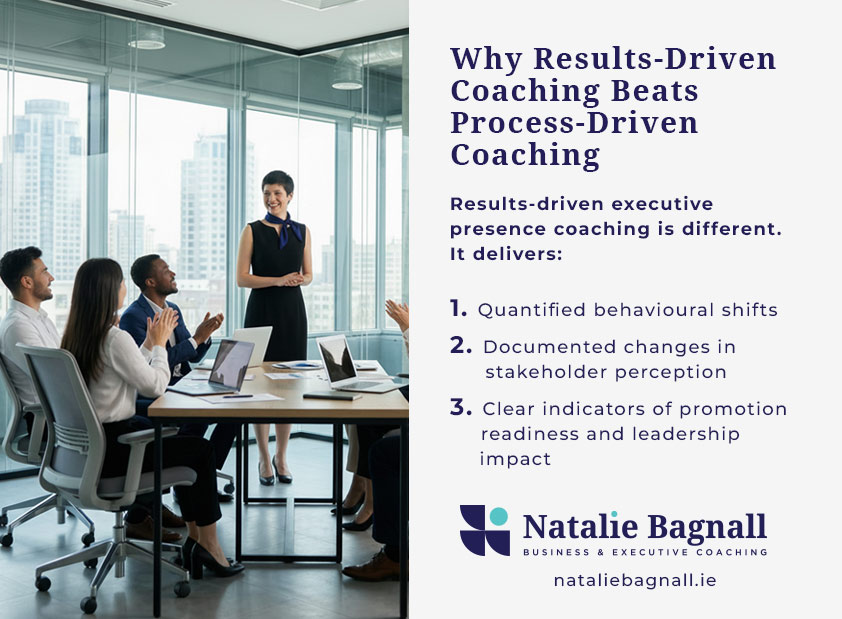
Why Results-Driven Coaching Beats Process-Driven Coaching
Traditional coaching service engagements in Ireland are often process-heavy: rich conversations, thoughtful development plans, and open-ended timelines.
Results-driven executive presence coaching with with Natalie Bagnall is different. It delivers:
- Quantified behavioural shifts
- Documented changes in stakeholder perception<
- Clear indicators of promotion readiness and leadership impact
For HR and L&D leaders, this means greater confidence in ROI. For leaders, it means confidence that is earned – not performed.
Executive presence is not a personality trait. It is the consistent experience others have of you as a leader.
When coaching services are anchored in clarity, behaviour, and validation, confidence follows — naturally and credibly.
Frequently Asked Questions
- Q. How long does executive presence coaching with coaching style metrics take in Ireland?
Typically 12–16 weeks to achieve measurable, validated change. This is a focused transformation, not an indefinite engagement. - What coaching style metrics and results can I measure? Stakeholder perception scores, behavioural frequency data, and indicators linked to influence, readiness for progression, and leadership credibility.
To see how your business or team can benefit from our coaching services get in touch today for more info.